New training classes will begin at our Tri-Stake FHC in January.
Starting January 11th a new class on using RootsMagic and new FamilySearch will begin. Currently that class is full but, you can contact me (see contact area below) to get on the waiting list or to let me know if you are interested in the next set of classes.
On Tuesday mornings I will teach some basic classes on using new FamilySearch. I want to limit this class to about four people at a time for those who prefer a slower approach to learning the new processes. Please contact me (see contact area below) and let me know if you are interested.
We will also be teaching some fast-track classes on new FamilySearch on Wednesday mornings and evenings beginning in mid January.
Here is an update on the new FamilySearch classes:
The Tri-stake Family History Center is offering more fast track training classes on new familysearch. The first two week course will be held on Wednesday, January 13th and Wednesday, January 20th in the Primary Room (on the South side of the building) of the Granite South Stake Center (10000 So. 2100 E). You may choose to attend the classes from either 10-12 am or 7-9 pm on those days. These classes are open to anyone who wants to learn how to use the new FamilySearch program. Please come and join us!
29 December 2009


18 November 2009
RootsMagic Announcement - BIG-BIG-BIG!!
I think everyone knows how much I like RootsMagic Software. I have just always found it to be easy for people to understand, easy to use, and yet extremely powerful with it's variety of features. Today RM announced a free version of RootsMagic for those genealogists out there who still want to use their software package of choice, but also want to access new FamilySearch and share data.
This is a terrific opportunity to try out the program. There is a full trial version as well. So now, you don't have to manually enter data in new FamilySearch and then manually copy the information into your program. USE ROOTSMAGIC Essentials and find out just how easy it really is!
RootsMagic Releases Free Genealogy and Family Tree Software
“RootsMagic Essentials” Brings Free Tools for Family History
SPRINGVILLE, Utah. — November 18, 2009 — RootsMagic, Inc. announced the immediate availability of RootsMagic Essentials, free desktop genealogy software based on their award-winning RootsMagic 4 system. RootsMagic Essentials contains many core features found in its namesake that allow the public to easily start tracing their family trees.Essential Features for Everyone
“Many of our users have told us that they have friends and family members who are interested in getting started in family history but aren’t ready to invest in a more comprehensive package like RootsMagic,” said Bruce Buzbee, president. “RootsMagic Essentials gives them the features they need to start researching and recording their family tree at a price that can’t be beat—free!”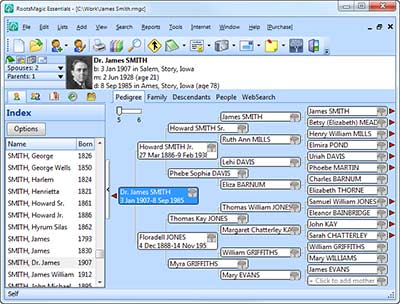
Free and Available Now
RootsMagic Essentials is available now for free at http://www.rootsmagic.com. Users of other genealogy software products will find it easy to experiment with RootsMagic Essentials using their own data. RootsMagic Essentials can directly import data from PAF, Family Tree Maker (through 2006), Family Origins, and Legacy Family Tree. It can also read and write data using the popular GEDCOM format.“We’re excited to make RootsMagic Essentials available to the community,” said Michael Booth, vice-president. “Our mission is to provide ’software to unite families’ and our hope is that RootsMagic Essentials will encourage more people to record their family trees and connect with their family histories”.
About RootsMagic, Inc.
For over 20 years, RootsMagic, Inc. has been creating computer software with a special purpose—to unite families. One of our earliest products- the popular “Family Origins” software, introduced thousands of people to the joy and excitement of family history.That tradition continues today with “RootsMagic”, our award-winning genealogy software which makes researching, organizing, and sharing your family history fun and easy. “Personal Historian” will help you easily write and preserve your life stories. “Family Reunion Organizer” takes the headaches out of planning those important get-togethers. And “Family Atlas” creates beautiful and educational geographic maps of your family history.
For more information, visit http://www.rootsmagic.com.
Source: RootsMagic, Inc.
26 October 2009
Excited to Use new FamilySearch?
Now that new FamilySearch is being released in the Salt Lake Valley many questions are coming up about how best to learn to use the program. Most of the temple districts around the U.S. and other parts of the world have been using nFS for up to two years now and users have been creating new lessons and tools to help others learn the process. These are tools beyond the E-Learning classes that are available within nFS.
I can’t say which of the lessons or tools are the “best” because each individual is different and learns in different ways. So, one method may work better for you than another. I’d suggest you browse through the different offerings and decide for yourself. You may want to take the E-learning classes first to establish your knowledge of the basics and then, use some of the others for their more detailed solutions to problems. Problems are often complicated and can best be explained through examples.
Here are several of the best places to learn to use nFS.
1. E-Learning classes on nFS. Log in to nFS, click on HELP CENTER, and then on the Training and Resources tab. On that tab you will find the links to the E-Learning Courses available to you. www.new.familysearch.org Remember to check back occasionally because your list of classes will update as needed.
2. FHC Lesson Manuals from a FHC in Florida written by Miles Meyer. Scroll down to the applicable new FamilySearch lessons.
3. New FamilySearch videos prepared by John Willis from a California FHC. The list of classes are available on video to view or to download. The links to specific classes to view are as follows: (allow time for download of each video.)
5. BYU – Religion 261 manual for new FamilySearch and other programs
6. Introduction to new FamilySearch
7. A simple overview of nFS
8. How to use nFS correctly (74 page manual by George Scott – Lindon, Utah FHC)
9. A casual overview of new FamilySearch – (48 page manual)
10. How to teach nFS to members (a basic outline by Laurie Castillo)
If you locate lessons and tools that I have missed, please let me know and I will add them to the list.
I can’t say which of the lessons or tools are the “best” because each individual is different and learns in different ways. So, one method may work better for you than another. I’d suggest you browse through the different offerings and decide for yourself. You may want to take the E-learning classes first to establish your knowledge of the basics and then, use some of the others for their more detailed solutions to problems. Problems are often complicated and can best be explained through examples.
Here are several of the best places to learn to use nFS.
1. E-Learning classes on nFS. Log in to nFS, click on HELP CENTER, and then on the Training and Resources tab. On that tab you will find the links to the E-Learning Courses available to you. www.new.familysearch.org Remember to check back occasionally because your list of classes will update as needed.
2. FHC Lesson Manuals from a FHC in Florida written by Miles Meyer. Scroll down to the applicable new FamilySearch lessons.
3. New FamilySearch videos prepared by John Willis from a California FHC. The list of classes are available on video to view or to download. The links to specific classes to view are as follows: (allow time for download of each video.)
- Features and benefits of nFS and common errors
- Maintaining your Family Tree with nFS
- Linking generations in nFS
- Adding new individuals to nFS
- How to prepare submission sheets for ordinances
5. BYU – Religion 261 manual for new FamilySearch and other programs
6. Introduction to new FamilySearch
7. A simple overview of nFS
8. How to use nFS correctly (74 page manual by George Scott – Lindon, Utah FHC)
9. A casual overview of new FamilySearch – (48 page manual)
10. How to teach nFS to members (a basic outline by Laurie Castillo)
If you locate lessons and tools that I have missed, please let me know and I will add them to the list.
19 October 2009
Draper Temple District Starts Rollout
Well, our Draper Temple District was announced today for general release of new FamilySearch. The first 20 stakes in the District go live next Monday, October 26th! The last five stakes in Draper will go live the following Monday on November 2nd. To see the details of which stakes are included go to: Draper Utah Stakes - Announced Release Dates
09 October 2009
Utah Valley PAF Users Group Meeting
Sorry this is so late but I've been away for a few weeks...need to get busy and add some more articles. :)
UTAH VALLEY PAF USERS GROUP MEETING
The next regular, second-Saturday-of-the-month meeting of the Utah Valley PAF (Personal Ancestral File) Users Group will be on Saturday, 10 Oct 2009, from 9 am until noon in the Edgewood/Riverside LDS Chapel, 3511 North 180 East, Provo, Utah. The chapel is in the Provo "River Bottoms" behind the Jamestown shopping plaza on the east side of University Avenue. You get to it by turning east from University Avenue at 3700 North ("Will's Pit Stop") and then south on 180 East. There is a map showing the location on the group's website http://uvpafug.org .
The main presentation for this meeting will be THE GENEALOGY GAME SHOW by Robert Raymond. Think you can read a census record? Properly interpret old documents? Do online records have special pitfalls? Come and quiz yourself. This presentation provides a fun way for beginners to learn, experienced genealogists to review, and advanced genealogists to challenge their knowledge of interpreting records and genealogical skills. Robert Raymond is a genealogical technologist. He's a 40 year veteran of genealogy and a 30+ year veteran of computers. Robert works for FamilySearch International and previously worked for The Generations Network (Ancestry.com). He holds over a dozen patents and received a Masters Degree in Electrical (Computer) Engineering from BYU where he was a Kimball Scholar. Robert is a popular presenter and a shadow writer for one of the most popular genealogical blogs on the web.
Following the main presentation there will be several classes taught concerning technology and family history. As usual, there will be something for everyone at all levels of expertise. The classes currently scheduled for this meeting are the following: (1) How to do FamilySearch Indexing, by Duane Dudley; (2) Getting to Know New FamilySearch (Class 1 of 4), by George Scott; (3) Genealogy on Your MAC, by Venita Parry; (4) Q&A: The Genealogy Game Show, by Robert Raymond; (5) Video of last month's main presentation by Crista Cowan, If You Get Stuck Going Backward, Go Forward: Tracing Descendants of Your Ancestors; (6) Ancestral Quest, by Gaylon Findlay; (7) Legacy, by Dean Bennett; and (8) RootsMagic, by Bruce Buzbee.
10 September 2009
Interested in Utah History?
Researching the Utah State Archives
Utah Government Records and History
Utah Archives Month programs planned
 The Utah State Archives will observe Utah Archives Month throughout October with weekly events each Wednesday at noon. Classes geared to community and family historians will be offered each week. The statewide theme for 2009 is “Connecting With the Human Experience.”
Janina Chilton, State Hospital historian, will examine the history of the State Hospital on October 7.
Laurie Bryant, retired paleontologist and citizen historian, will present “Away from the Smoke and Dust: A Century on Salt Lake City’s East Bench,” a slideshow and talk on the history of the 15th & 15th neighborhood, on October 14.
Alan Barnett, lead reference archivist at the Utah State Archives, will discuss the growth and development of Sugar House, including a history of the territorial prison, on October 21.
“Wake the Dead,” a popular class on family history sources and research in Utah, will be presented by Tony Castro, reference archivist at the Utah State Archives, on October 28. A tour of the research center is included.
All events will be held in the Courtyard Meeting Room in the State Archives Building, 346 S. Rio Grande Street (455 West), Salt Lake City. An exhibit of capitol artifacts is on display in the lobby of the Archives building. The display includes notable artifacts, such as a capitol dome light, original office furnishings, historic photographs, design submission competition entries, program of competition booklets, a piece of granite, and commemorative items.
NOTE:
Here are some links to the Utah Archives that may be of great benefit in your research.
Research Guides to Utah State Archives
Learn all about the resources available for Utah.
Utah Digital Archives
The archives include such records as Utah Death Certificate images from 1904-1956; Sanpete County death register, 1898-1904, the Utah Burials Database and Board of Pardons applications from 1892-1949.
Utah Digital Newspapers
This archive contains digital images of many, many Utah historical newspapers. It is one if the best resources you can use to really "get to know" your ancestors.
Utah State Archive
This site will tell you everything you want to know about the state of Utah.
P:ioneer: Utah's Online Library
Find digital resources of historical significance from a variety of digital collections in Utah. Some of the collections material is rare, hard-to-find and may be unavailable anywhere else. You can find digitized photographs, manuscripts texts, maps, audio & video recordings, transcripts, books, yearbooks, newspapers, theses and dissertations, and digital exhibits, as well as "born digital" items.
Each of these collections provide free, online access to digitized material.
Latest on nFS Rollout in Utah/Idaho
If you check out the Utah/Idaho Release website you will see that the balance of the Stakes in the Idaho Falls temple district go live to general release on September 14th (next Monday). This involves about 30 stakes.
Also, the first 10 stakes in the Provo temple district in Utah go live the same day, September 14th! This includes a couple of stakes in Salem, Santaquin, Spanish Fork and Provo.
To the rest of you, remember to get ready by following the instructions listed in my article "The Final Readiness for nFS".
08 September 2009
Time for UVPAFUG Again - Come Join Me
UTAH VALLEY PAF USERS GROUP MEETING
The next regular, second-Saturday-of-the-month meeting of the Utah Valley PAF (Personal Ancestral File) Users Group will be on Saturday, 12 Sep 2009, from 9 am until noon in the Edgewood/Riverside LDS Chapel, 3511 North 180 East, Provo, Utah. The chapel is in the Provo "River Bottoms" behind the Jamestown shopping plaza on the east side of University Avenue. You get to it by turning east from University Avenue at 3700 North ("Will's Pit Stop") and then south on 180 East. There is a map showing the location on the group's website http://uvpafug.org .
The main presentation for this meeting will be by Crista Cowan on IF YOU GET STUCK GOING BACKWARD, GO FORWARD: TRACING DESCENDANTS OF YOUR ANCESTORS. Are you stuck in your march back through time identifying ancestors? Turn around. Revitalize your research. Rekindle your desire to continue with some success. Descendancy research utilizes much of the same methodology as ancestral research, but can lead to a whole new way of looking at your genealogy. Often it can lead to the discovery of cousins who have missing pieces of the puzzle needed to complete your picture of common ancestors.
Crista Cowan is the owner and operator of Legacy Family History Services. She has been involved in family history research for over 20 years, actively doing client research for the past eight years. She specializes in descendancy research, Jewish Immigration, and sharing family history with the genealogically challenged. Crista is an active member of the Association of Professional Genealogist (APG), currently serving her second term as president of the Utah Valley chapter. She regularly teaches Family History classes at her local LDS Family History Center and has been employed at Ancestry.com since 2004.
Following the main presentation there will be several classes taught concerning technology and family history. As usual, there will be something for everyone at all levels of expertise. The classes currently scheduled for this meeting are the following:
- Documenting Sources in PAF 5 and nFS, by Duane Dudley
- Getting Organized in Your Research, by Beth Ann Wiseman
- Genealogy on Your Mac, by Venita Roylance
- Q&A: Descendancy Research, by Crista Cowan
- Video of last month's main presentation - Using Your Digital Camera, by Mary E. V. Hill
- How Legacy Works (cont'd), by Joel Graham
- RootsMagic, by Sue Maxwell
- Ancestral Quest, by Gaylon Findlay.
02 September 2009
The Final Readiness for nFS

As of August 24th all remaining temple districts (Utah/Idaho) received their official preparation notice for new FamilySearch. This rollout began immediately with 29 stakes in the St. George district going live on Aug. 31st. 13 stakes in Idaho Falls district go live on September 7th as will the remaining stakes in the St. George district. All remaining stakes in Utah/Idaho will only receive about 7 days notice, so we need to be prepared.
1 - The first think you need to do is check the new.familysearch.org Utah and Idaho Release website often. Clicking on the temple district will show the rollout dates for each temple district.
2 - Consultants must follow the instructions on the "Prepare" tab and the "Report" tab. Priesthood leaders should also follow the instructions..
3 - A new updated E-learning course has been added to your list in the HELP center. Please retake the lesson. If you already have access to nFS go to the Training and Resources tab under HELP in new FamilySearch to locate the lessons.
4 - To minimize the impact on the FamilySearch Support Missionaries, please use the HELP center to try to answer your own questions first. When you first contact Support, the Missionaries use the same HELP files to try to resolve your questions.
5 - If you want a good understanding of FamilySearch Support with its purpose and functionality, see the article written by the Ancestry Insider.
6 - A new Family History Course has been prepared for use by consultants in their ward or branch under the direction of the Bishop. Stake Presidents and Bishops have been sent a copy of the new manuals.
The Instructor's Guide to Temple and Family History Work is available for order online at the LDS Distribution Center for $5.50 (order #35804000). There are 7 lessons, 3 workshops, and a DVD.
The Student Manual for this class is the new Member's Guide to Temple and Family History Work (#36795000). Currently the Member's Guide must be ordered over the phone and is being limited to 10 copies. Phone: 800-537-5001.
7 - As a reminder to Priesthood Leadership you can review your responsibilities here.
8 - Continue to check for classes being taught at the Family History Library in downtown Salt Lake.
When the time for PERFORMANCE arrives,
the time for PREPARATION is past.
30 August 2009
29 St. George Utah Stakes go live Aug. 31 on nFS
New FamilySearch is being released throughout Utah's Temple Districts by stakes in those districts. 29 of the 44 Stakes in the St. George Temple district will be live August 31st! That means that all general membership of the LDS Church will be able to sign-in and access new FamilySearch. Happy Hunting!
26 August 2009
U.S. Federal Census Records Made Simple
Probably the most used resource for genealogists is the census record. You have the ability to build the family structure and extract basic vital information by using the data found in these records. The U.S. Federal census records were compiled for every ten year period beginning in 1790.
Censuses were first implemented by Congress and were generally used to determine taxes and for determine apportionment for seats in the U.S. House of Representatives. In the beginning, only the head of household's name was gathered along with a count of people in the household. However, not all people were treated equally! For instance, slaves were counted separately and no names were recorded during the early years. Each census year after 1790, additional information was gathered from the people. It was 1850 before a census asked for the names of every member of the household.
As all census records are “not equal”, neither is the accuracy of the information. There are original documents, hand-written copies of originals and summaries of the censuses. Accuracy was dependent on a number of things including illegible handwriting, the desire of the enumerator to follow the established rules, and the desire of the household members to provide accurate answers to questions. Simply put, some people did not know how to spell names or even know their age. Those things were not as important or as common as they are today. Also, people stretched the truth in some cases to avoid taxes or the law. Some even avoided the enumerator. So don’t think you have the wrong person just because he aged 14 years between censuses, or she only aged 6 years!
Sometimes enumerators were required to make copies of their records which required manually hand-copying their originals to a new paper or form. Some of the originals were even lost or destroyed. Over the years, some census records were destroyed in fires, lost in transport, misplaced or thrown away by mistake. The entire 1890 census was burned in a fire in Washington DC in 1921.
Of the census records that have survived over the past 220 years, copies can be found indexed as well as preserved in both microfilm and digitized images. This brings a new level of frustration to the genealogist. Not all data is indexed correctly, nor are the images all of the same clarity and quality.
Indexes and images can be found online now in both free locations and subscription websites. Each site has its own search engine and level of quality. New technology helps to improve the accuracy and quality and, in many cases, the records are being re-indexed and re-scanned.
Locating Census Records Online - Your first question may be “where can I find them?” To that question I have provided the links and directions to the websites you can use, as well as, links to tips for using census records in your research. So if you haven’t ventured into your own research, give census records a try.
To gain free access to census indexes and images from home:
Utah Educators and Students -
You have access to Heritage Quest if you or your child is a registered user of my.uen.org. If you are not registered yet, click here.
K-12 Schools
Information about access in other states
Note: Free access to Heritage Quest is provided at Family History Centers located in various LDS Church buildings around the country. Use the Family History Center portal: access through the FHC portal of subscription sites located on the computers desktop.
FamilySearch Records Search - currently has the following census records online 1850, 1860, 1870, 1880 (no images), 1900, 1920 (partial index only)
US GenWEB – has some records partially online-some indexed and some images. Access this easily by state through this link.
National Archives Libraries - If you visit or live in a State that has a NARA location you can access census records. Here is a link to the NARA locations.
Census Finder - locate the available websites that contain free images or transcriptions of census records from all over the world.
Access Census Records By Subscription: Access to some census records can be of higher quality and easier to use if you subscribe to the companies website.
Ancestry.com has the most complete set of census records available online. If you have a subscription, click here.
The LDS Church provides free access to the census images for Ancestry at the Family History Library in Salt Lake City and at all other Regional Family History Centers around the country. See a list and links for Regional Family History Centers .
The LDS Church also provides free access to the following subscription websites through the FHC portal at ALL Family History Centers, not just the regional ones.
Footnote.com: Currently this subscription website has the 1860 and 1930 US census records.
World Vital Records: C ontains some indexes. Most images can only be browsed at the present time.
One other subscription website contains some images and indexes. That is Genealogy.com: Only about half of the census years are indexed.
Tips for using Census records - Use the following links to great sources of information.
US Census explained
Clues in census records, 1790-1840
Cues in census records, 1850-1930
Reading the census
Federal census facts
Tips for using Census records at Heritage Quest online
Finding Families in Pre-1850 Censuses
Census Questions and Research Tips
Searching Census Records
U.S. Federal Census Dates
Censuses were first implemented by Congress and were generally used to determine taxes and for determine apportionment for seats in the U.S. House of Representatives. In the beginning, only the head of household's name was gathered along with a count of people in the household. However, not all people were treated equally! For instance, slaves were counted separately and no names were recorded during the early years. Each census year after 1790, additional information was gathered from the people. It was 1850 before a census asked for the names of every member of the household.
As all census records are “not equal”, neither is the accuracy of the information. There are original documents, hand-written copies of originals and summaries of the censuses. Accuracy was dependent on a number of things including illegible handwriting, the desire of the enumerator to follow the established rules, and the desire of the household members to provide accurate answers to questions. Simply put, some people did not know how to spell names or even know their age. Those things were not as important or as common as they are today. Also, people stretched the truth in some cases to avoid taxes or the law. Some even avoided the enumerator. So don’t think you have the wrong person just because he aged 14 years between censuses, or she only aged 6 years!
Sometimes enumerators were required to make copies of their records which required manually hand-copying their originals to a new paper or form. Some of the originals were even lost or destroyed. Over the years, some census records were destroyed in fires, lost in transport, misplaced or thrown away by mistake. The entire 1890 census was burned in a fire in Washington DC in 1921.
Of the census records that have survived over the past 220 years, copies can be found indexed as well as preserved in both microfilm and digitized images. This brings a new level of frustration to the genealogist. Not all data is indexed correctly, nor are the images all of the same clarity and quality.
Indexes and images can be found online now in both free locations and subscription websites. Each site has its own search engine and level of quality. New technology helps to improve the accuracy and quality and, in many cases, the records are being re-indexed and re-scanned.
Locating Census Records Online - Your first question may be “where can I find them?” To that question I have provided the links and directions to the websites you can use, as well as, links to tips for using census records in your research. So if you haven’t ventured into your own research, give census records a try.
To gain free access to census indexes and images from home:
Utah Educators and Students -
You have access to Heritage Quest if you or your child is a registered user of my.uen.org. If you are not registered yet, click here.
K-12 Schools
Information about access in other states
Note: Free access to Heritage Quest is provided at Family History Centers located in various LDS Church buildings around the country. Use the Family History Center portal: access through the FHC portal of subscription sites located on the computers desktop.
Other free sites with census records:
FamilySearch Records Search - currently has the following census records online 1850, 1860, 1870, 1880 (no images), 1900, 1920 (partial index only)
US GenWEB – has some records partially online-some indexed and some images. Access this easily by state through this link.
National Archives Libraries - If you visit or live in a State that has a NARA location you can access census records. Here is a link to the NARA locations.
Census Finder - locate the available websites that contain free images or transcriptions of census records from all over the world.
Ancestry.com has the most complete set of census records available online. If you have a subscription, click here.
The LDS Church provides free access to the census images for Ancestry at the Family History Library in Salt Lake City and at all other Regional Family History Centers around the country. See a list and links for Regional Family History Centers .
The LDS Church also provides free access to the following subscription websites through the FHC portal at ALL Family History Centers, not just the regional ones.
Footnote.com: Currently this subscription website has the 1860 and 1930 US census records.
One other subscription website contains some images and indexes. That is Genealogy.com: Only about half of the census years are indexed.
Tips for using Census records - Use the following links to great sources of information.
US Census explained
Clues in census records, 1790-1840
Cues in census records, 1850-1930
Reading the census
Federal census facts
Tips for using Census records at Heritage Quest online
Finding Families in Pre-1850 Censuses
Census Questions and Research Tips
Searching Census Records
U.S. Federal Census Dates
24 August 2009
New FamilySearch begins Release in Draper Temple District
24 August 2009To: Family History Consultants in the Draper Utah Temple DistrictThis e-mail is to notify you that within the next several weeks, the stake in which you live will begin using a new Web site as part of the process for preparing ancestral names for the temple. The Internet address for the new Web site is new.familysearch.org. You should be able to register in the new Web site immediately upon receipt of this e-mail. TempleReady will no longer be used for this process.The attached information packet will help you prepare to help members use this new process once the temple begins accepting the new Family Ordinance Request forms in place of TempleReady disks. Copies of the attached release packet will also be sent by U. S. mail. Center directors will receive their copy directly from the Family History Department. The copy for family history consultants will be sent to their bishop in their normal weekly priesthood mailing. An informational DVD will accompany the copy sent by mail.Important note: You must have the Adobe Reader installed on your computer to view the attachments in this e-mail. It may be downloaded for free at www.adobe.com. To install the Adobe Reader, click on the Get Adobe Reader button on the Adobe Web site home page, and follow the instructions.It is important for you to follow the preparation instructions found on the New FamilySearch Utah and Idaho Release section of the consultant registration website. Simply go to consultant.familysearch.org and click on the Click here to go to the Utah and Idaho instructions button to view the preparation instructions.We will send you a follow-up e-mail announcing the actual release date approximately one week before the release in your stake.If you have any questions, please contact FamilySearch Support.Sincerely,Toll-free: 1-866-406-1830
21 August 2009
Volunteers needed at FH EXPO in Sandy
Consultants or friends of consultants: Trying to watch your pennies these days? If you would be interested in volunteering one day of the two-day FH Expos conference in Sandy, Utah next week, contact me below. If you work one day you can attend classes for free on the other day. To see more about the Expo see the article below.
19 August 2009
FHExpos - Reminder of Salt Lake Expo in Sandy, Utah

Just a reminder that the we have a great opportunity next week (August 28th and 29th) to learn some new family history techniques and technologies to help in our family history research and temple work. (See the previous article here).
You have until Monday the 24th to pre-register and save $10. Also new this year is the ability to pay for only one or two classes at $12 each. The Church is also providing free access to the classes presented by FamilySearch if you are a registered consultant. You must have the coupon that was emailed to each consultant.
If you have never attended one of these expo's you need to take advantage of it being here in Sandy. These conferences are the least expensive ones you will ever attend, and, these is a terrific choice of classes to attend with great speakers.
If you are a consultant and have not been trained in using new FamilySearch, please make every effort to be there....you won't be sorry. The free classes for consultants are on Saturday afternoon from 1 to 5 pm.
As soon as you register you have online access to all the handouts for the conference.
Please attend and enjoy!

11 August 2009
World Vital Records - Free for 3 Days!
PROVO, UT, August 11, 2009 – WorldVitalRecords.com, an online family history resource, today announced the addition of the largest number of records to be released in a single day since the site launched in 2006. To commemorate this milestone, for the first time WorldVitalRecords is offering free public access to its entire online collection of historical and genealogical records beginning August 11 and continuing through August 13, 2009. The public will have unlimited access to more than one billion records in over 11,000 databases from around the world including newspapers, census, birth, marriage, death, immigration and military records; family trees; stories and publications; and yearbooks.
Subscribe to:
Posts (Atom)