02 February 2011

Mark Your Calendars - UVPAFUG Meeting!

UTAH VALLEY PAF USERS GROUP MEETING *

The next regular, second-Saturday-of-the-month meeting of the Utah Valley PAF (Personal Ancestral File) Users Group will be on Saturday, 12 Feb 2011, from 9 am to noon in the LDS "Red Chapel", 4050 North Timpview Drive (650 East), Provo. Information about the Users Group, main presentations, classes, and class notes are available on the Group website http://uvpafug.org and the press releases are at http://blog.uvpafug.org/ . The main presentation for this meeting will be by Ron Tanner on THE FUTURE OF NEW FAMILYSEARCH. This will be a description of what is happening lately on the new.familysearch.org website and the planned integration of new.familysearch.org into www.familysearch.org. We will also discuss the vision of new.familysearch.org and how we are working to achieve this vision. The vision works to resolve some of the frustrations experienced by all users such as fixing or removing bad data, fixing relationships, sourcing, combining and separating, and recovering when someone messes up the data.

Ron Tanner is a Product Manager for the Family History Department of the LDS Church and assists in the research and design of new FamilySearch and companion products. Currently Ron's assignments include overall product delivery for new.familysearch.org, the Asia rollout, and future product direction for FamilySearch. Ron has a Master's Degree in Computer Science from BYU and has previously worked as a product manager and engineer at Novell, Citrix, and Bell Laboratories. Ron and his wife CheRee live in Provo and have four children.
Following the main presentation there will be several classes about family history and technology with something for everyone at any level of expertise. The teachers and classes presently scheduled for this meeting are as follows: 

  1. Techniques & Tools for Streamlining Your Research, by Laurie Castillo
  2. MAC: Uploading to Ancestry and Creating a Web Site, by Ron Snowden
  3. Personalized Help, by Claudia Benson & Finn Hansen
  4. Q&A: The Future of New FamilySearch, by Ron Tanner
  5. Video of last month's main presentation: ePublishing, by Barbara Renick
  6. Ancestral Quest, by Merlin Kitchen
  7. Legacy, by Joel Graham
  8. RootsMagic, by Diana Olsen.
All meetings of the Users Group are open to the public whether members of the Group or not. *The Users Group has the goal of helping individuals use technology to further their family history and there are usually 100-125 attending the monthly meetings on the second Saturdays. 

Meet Thomas MacEntee - Speaker at RootsTech Conference

As you may have noticed on my blog I'm an official blogger for the RootsTech Conference being held in Salt Lake City, Utah at the Salt Palace next week, February 10-12, 2011.

What a great opportunity I had to interview Thomas MacEntee who is one of the presenters/ speakers/ facilitators at RootsTech! Just in case you have always wondered, he pronounces his surname with the emphasis on the EN. (mac-EN-tee). It's kind of like spa-GE-tee!  I hope he likes the association!


Thomas, you are the mind behind GeneaBloggers, an internet blog that helps other bloggers throughout the genealogical community. Can you tell us about yourself, your blog purpose, and why you have an interest in presenting at RootsTech?

·         I started blogging in late 2006 to capture family stories as my mother’s early on-set Alzheimer’s Disease progressed. At that time I became aware of other bloggers also memorializing their family members and ancestors with a focus on genealogy.

·         Up until late 2008, I worked in the information technology field so I was quite adept at the Internet and various computer programs.  But working for global law firms never allowed me to use some of the newer 21st century technologies including blogs and other forms of social media.

·         In mid-2008, when more and more genealogy and genealogy blogging folks got on Facebook, I realized there was enough of a momentum to start GeneaBloggers. I did so in January 2009 and it has flourished ever since. While we had 400 genealogy and family history blogs at that time, we now list over 1,600 from around the world.

·        When I was laid off in 2008, I decided to “repurpose” myself by converting my hobby – genealogy – from passion to a business. With my certificate in Genealogical Research from Boston University which I earned in 2010, I decided to start my own business High-Definition Genealogy.

·        One aspect of my business draws from my many years’ experience as a technical trainer – I now travel all over the United States and Canada teaching genealogists and genealogical societies how they can leverage technology to improve the genealogy experience.  I also teach online webinars from the comfort of my home in Chicago using virtual presentation technology.

·       I’m presenting three panel discussions at RootsTech so attendees can learn more about the issues involved with certain technologies currently being used by the genealogy community. 


  As you mentioned you are presenting three different sessions or panel discussions at RootsTech, one each day. Your Thursday session is "Self-Publishing for Genealogists and Genealogical Societies". Who might benefit from this session and why? Are you focusing on publishing your own genealogy or on writing skills?

The focus for the self-publishing panel is not on how to write or how to acquire those skills but more on how to take a finished work and produce a published book. The publishing landscape has really changed in the past five years and now authors can self-publish, offer print-on-demand services to their customers, and even create “e-books” for platforms such as the Kindle or the Nook. Genealogical society leaders will want to attend so they can learn how to convert their current publications over to a more efficient publishing model.


In your Friday session on “Genealogy Blogs” you will be facilitating a panel discussion  with other bloggers. Is this session strictly for current genealogy bloggers? If not, why should others attend? Are you teaching attendees how to blog, why to blog, or how to utilize blogs?

The actual title is “Genealogy Blogs: Impact and Influence in the Genealogy Community” and there will be a panel of several leading genealogy bloggers including DearMYRTLE. Given that most RootsTech attendees are of the “techie” type and have a knowledge of blogs, the discussion will focus on why a genealogist or genealogical society should have a blog among other topics. The main focus will be discussing how the presence of genealogy blogs have influenced the genealogy industry over the past three years and what the future holds for the partnership of blogging and genealogy.


Your Saturday session is "Virtual Presentations Roundtable." Can you explain what a roundtable is and why attendees might be interested in this format?

I am very excited about this session not only because it will feature genealogists currently using virtual presentation technology, but the entire session will be broadcast as a live webinar by Legacy Family Tree Webinars. If you’ve ever wondered how you could deliver genealogy educational content to people all over the world, this is the session where we explain the technology and also use it at the same time – talking the talk and walking the walk!


With all your expertise in the genealogical community, I'd like your opinion about attending RootsTech. There are people out there who cannot attend RootsTech this year but want to, while others may be questioning whether they might benefit from attending. Why should a genealogy beginner attend RootsTech? Why should experts still plan to attend?

A genealogy beginner should attend RootsTech to understand that this is not your grandmother’s genealogy – meaning we won’t be donning presentation gowns, opera gloves and discussing pedigrees. The new genealogist knows how to use all the latest technology not only to improve the “hunt” but also to make the entire search for ancestors a 3-dimensional experience.

Genealogy experts need to attend to be able to keep their ear to the rail and learn what others are using as they work with clients or with societies and organizations.  It is so easy these days – especially with telecommuting – to exist in a vacuum which can lead to a technology knowledge lag. For me, the networking opportunities and the ability to share ideas is the most promising aspect of RootsTech.

What do you want attendees of your sessions and RootsTech in general to take with them from their experience at RootsTech?

I want attendees – as well as those following RootsTech from afar via live blogging and other social media – to understand that we are at a critical juncture in the genealogy industry. We have to be ahead of the curve on current and developing technologies instead of traditionally being behind that big tidal wave. The next few years are critical. Genealogists and genealogical societies can no longer afford to ignore the technology that can help extend their reach and improve their research methods.

Thanks Thomas and we look forward to hearing from you at RootsTech!
~ ~ ~ ~ ~
Now back to my original comment about the pronunciation of Thomas' surname... Thomas told me that there is a genealogy story behind the pronunciation: the original surname was McEntee (which is why he pronounces it that way). The story goes that his great-grandfather Elmer McEntee changed it to MacEntee around 1900 so he could get work. At that time there was quite a bit of anti-Irish sentiment in New York so he decided to make the surname look like a Scots surname.

This is a prime example of why I tell people to never rely on the spelling of a name to determine who your ancestors might be! 

If you haven't already done so, give some serious consideration to attending RootsTech next week. You won't be sorry!


Disclosure: I have been designated as a RootsTech Official Blogger which entitles me to free registration and other perks.  Follow this blog and Twitter for updates live from the conference.

01 February 2011

Browsing Historical Microfilmed Records

By now most of you know that you can search MILLIONS of historical microfilmed records online for FREE at FamilySearch.org. These records have been indexed and you can search by name, dates, and places.  But did you know that you can SEE many more historical records online that have not yet been completely indexed? They have been WAYPOINTED!

So what is waypointing? Waypointing is a new tool being used by FamilySearch that allows approved users to "markup" or "waypoint" a microfilm digitally. The name of the database, the type of data, and the date ranges are all marked or indexed for that particular film. Then the database is uploaded to FamilySearch. You can't SEARCH on these images but you can BROWSE through them, find your ancestor and copy the images. You might have to scroll through hundreds of images, but all the images are for a certain record type, location and time frame. Just think, you don't have to order the film, wait for it, and then go to a Family History Center to view it. You can search these films right from your computer at home, any time of the day. Eventually, these records will be completely indexed and searchable by name.

To find these records go to https://www.familysearch.org/ and locate the "Browse by Location" link. This will allow you to filter your search by Place, Date or Category. Or you can simply Search for the record type.

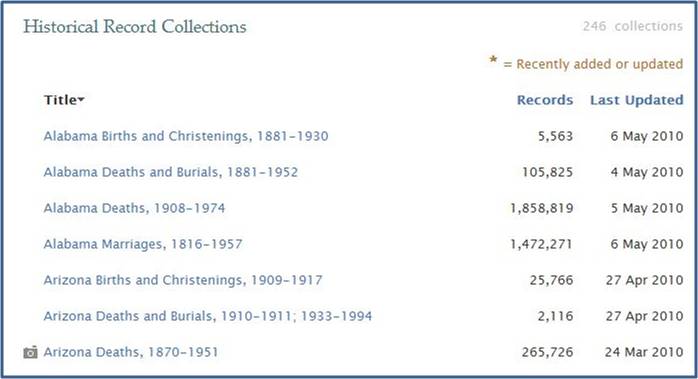
Filtering down to specific location collections you will see a list of the record sets that are available in FamilySearch for that area.


Further scrolling will reveal  collections that say "Browse Images". Selecting one of these will display the actual images from the record set. These records are not searchable by name, but can be browsed to find your ancestors.


So don't rely just on the indexed records, try the "Browse" images, too! Remember that the more we all index and waypoint the faster we will have MILLIONS more records available to us for free! Happy hunting for your ancestors!

If you want to get involved with FamilySearch indexing, click here.

Free Ancestry.com Data

I know, you wish that everyone could afford their own subscription to Ancestry.com but we know that's not possible. Even when visiting your local Family History Center you can access some data from Ancestry.com, but not all. Currently you have to use a subscription at your local library or one of the Family History Libraries for more complete access to the Ancestry.com databases.

However, there are over 260 FREE databases with information that might help you with your genealogical research and you can use them from the comfort of your home. You have FREE access to the indexes and in just a few cases you have the images. Then you ask, "What will indexes tell me when I can't see the images". Typically you get more clues and some direct evidence to help you piece together your jigsaw family history puzzle. But the trick here is to maximize your time and energy BEFORE you travel to your local library or Family History Center. Spending some time making your way through the free indexes and documenting what you find will help you do some final searching of the databases later, in less time.

The Ancestry Insider has put together a terrific spreadsheet of all the free databases on Ancestry.com, complete with links to each database. Check out the AI's list here. Utilize the data and then take your trip.

28 January 2011

FamilySearch Videos: Watch and Learn!

Over the last couple of years FamilySearch has posted a number of YouTube video's to help you learn more about genealogy and other related subjects. Just sit back and watch and you can learn without leaving the comfort of your own home.


Are you interested in where the 2.4 million microfilms are stored and how it all began? Watch these and learn more about the Granite Mountain Vault.

Granite Mountain Records Vault, Part 1 - FamilySearch Genealogy Records

Granite Mountain Records Vault, Part 2 - FamilySearch Genealogy Records


Inspirational: Do you need a little extra boost to get you started searching for your ancestors? The first video below, Woven Generations, is an introduction to segments originally shown at "A Celebration of Family History" as part of the 2010 NGS Conference held in Salt Lake City. The other segments are short family history vignettes.

FamilySearch - Woven Generations

FamilySearch - Letters from Estonia

FamilySearch - Clan McCloud


FamilySearch - Searching for Emma


Are you just getting started with your family history and not quite sure what to do? Check out the following video's.

Getting Started, Step 1 - Finding Easy Information (FamilySearch genealogy)

Family History Expo Coming to St. George Utah in February

It's time to get away from all the bad weather around the country and head to sunny St. George, Utah February 25-26, 2011 at the Dixie Center for the Family History Expo! The conference/expo is sponsored by Family History Expos, a private company. That would be Holly Hansen if you have ever attended one of the expos before.  (I hate the fact that I cannot attend this year so you go and fill me in on all the details, okay?)

Over 100 classes will be presented by more than 50 national and local speakers as well as staff from the Family History Library in Salt Lake City, Utah, and FamilySearch employees. With classes ranging from beginner to advanced topics, there is something for everyone. Many classes are dedicated to the latest techniques and technologies being used in genealogical research, as well as the most up-to-date information about different cultures being studied. You can review the class schedule at www.fhexpos.com/expos/

Exhibitors from throughout the U.S. will teach about the latest products and services available in the industry. FamilySearch affiliated software vendors will also be on site and happy to help you test their products “hands on” with new.familysearch.org (FamilySearch Family Tree). Some of the products and services showcased will include genealogy magazines, hardware, software, wall charts, and research services. Representatives from various genealogical societies will also be on site.

The Expo is a fantastic way to get more involved in Family History and socialize with hundreds of others who have the same interests as you!.

The following is from FamilySearch support and is directed to Family History Consultants, Center Directors, and Extraction/Indexing Directors and Assistants, and Priesthood Leaders:

You and members of your family history center as well as families in your ward may be interested in attending the upcoming St. George Family History Expo sponsored by Family History Expos (a private company).

There is no cost for attending the keynote address or visiting the exhibit hall. For those wishing to attend the classes, registration is $75 for both days ($65 if you preregister online) or $40 for a single day. For individuals wanting to attend a single class, the cost is $12 at the door. The following free classes will also be offered on Saturday for family history consultants, stake extraction directors and assistants, and priesthood leaders:

·         “Family History Work, a Vital Resource in the Work of Salvation.” This class will discuss the newly released Leader’s Guide to Temple and Family History Work: To Turn the Hearts, as well as new approaches to involve the ward council.

·         “Family History Centers and In-Person Assistance.” This class will discuss the evolving role of family history centers and how to integrate them more in family history research.

·         “Research Resources and Branching Out.” This class goes over the latest developments in indexing, the research wiki, forums, and online training, and it discusses how these resources can best be utilized.

The St. George Family History Expo could be a great opportunity for the ward members you are working with to learn more about finding their ancestors. You may want to share information about the expo with them.

All general questions about the expo should be directed to:
Family History Expos.com
P.O. Box 187
Morgan, UT 84050
E-mail: Expo@FHExpos.com
Phone: 1-801-829-3295
Web: http://www.fhexpos.com/expos/


If you have specific questions regarding FamilySearch or consultant training classes offered at the expo, they should be directed to: 
E-mail: support@familysearch.org                                                                                                                                              
Phone—U.S. and Canada (toll free): 1-866-406-1830                                                                                                                   
Phone—International: Go to http://contact.familysearch.org for more toll-free phone numbers.

To change your contact information with FamilySearch, reregister at: http://priesthood.familysearch.org or https://consultant.familysearch.org
To remove your registration, send your request to:
support@familysearch.org. Please include your name, ward name, and stake name.
Invite others to register at:
http://priesthood.familysearch.org or https://consultant.familysearch.org

26 January 2011

Elder Richard G. Scott to Speak at RootsTech

This message from FamilySearch Support is directed to Family History Consultants, Family History Center and Extraction/Indexing Directors, and Priesthood Leaders:


RootsTech is a new and unique conference where family history and technology come together. Yet, you do not have to be an expert in either one to greatly benefit from attending conference sessions. In addition to the full three-day schedule of excellent lectures, each day there will be time especially set aside for family history consultants. This free consultant training will be repeated each day, and the experience will be highlighted by a devotional presented by Elder Richard G. Scott of the Quorum of the Twelve Apostles on Saturday, February 12, 2011.

There are two options for consultants who want to participate and learn at RootsTech, which will be held at the Salt Palace Convention Center, Salt lake City, Utah, February 10–12, 2011:

Full RootsTech attendance at a discount— $75
For $75, family history consultants can choose from over 100 classes to attend over the three days of the conference. (The cost of lunch each day is not included in this price.) Class schedules and registration information can be found at rootstech.org. Or, to register now, click here, register as a “Regular Attendee,” and use registration code CONSULTECH11. There are so many relevant topics for genealogists and technologists that it may be difficult to decide which classes to attend.

Half-day consultant activities—free
Each day of the conference the same consultant training classes, taught by Family History employees, will be presented for free. To participate, consultants need to register and select the option “FH Consultant Training Classes,” enter the registration code consultfree11 and then choose which day they will attend and whether they are attending the Elder Scott devotional or not. With this option, access to the daily keynote address and the exhibit hall will be included. Additionally, on Saturday, February 12, 2011, is the special devotional presentation by Elder Richard G. Scott of the Quorum of the Twelve Apostles of The Church of Jesus Christ of Latter-day Saints. Attendance is limited to those who follow this registration process; you may attend the training classes on one day and still attend the devotional on Saturday. If you have a spouse who is not a consultant who may want to attend the devotional they must also register using the special registration code and select devotional attendance.

Consultants must register for the free events and pick up a badge when they arrive at the convention center. Registering to attend the free consultant activities does not allow you to attend any of the other conference course offerings.

Consultants who register for full conference attendance (option 1) must also register separately if they want to attend the Elder Scott devotional.

With these great offerings, we are confident you will want to attend at least one day of this wonderful annual conference.

There is a web page on the FamilySearch Research Wiki with details and Q&A, click here to go to the page, or go to the Wiki and search on “Consultant Training at RootsTech 2011.”

FamilySearch Kicks Off 2011 with the Addition of 90 Million New Online Records

Includes 18 Million Digital Images from 13 Countries

No doubt family history enthusiasts will have a heyday looking over the latest collection updates! The 18 million free, browsable digital images are just a sample of what should be a banner year as FamilySearch continues to plug away at digitizing its massive microfilm collection for online access. U.S. researchers will be excited to begin poring over the 3 million new digital images of U.S. naturalization records included in this update.

Patrons will also find 72 million new, searchable, indexed records to search for free thanks to FamilySearch’s cadre of online volunteer indexers and agreements with Ancestry.com and findmypast.com. Findmypast.com’s index to the 1881 and 1891 England and Wales censuses and Ancestry.com’s indexes for U.S. border crossings from Canada to U.S. and Mexico to U.S. can now be searched free of charge at FamilySearch.org.

See the table below for additional details of the latest collection updates.

Collection
Images
Records
Comment
Brazil, Catholic Church Records
588,020
Images added to the following collections: Sao Paulo, Rio Grande do Sul, and Rio de Janeiro
Canada, Ontario Deaths, 1869-1937, and Overseas Deaths, 1939-1947
188,756
Index only.
Canada, Ontario Marriages, 1869-1927
363,464
Index only.
Canada, Quebec Notarial Records, 1800-1900
71,036
Notary records from Montreal and Terrebonne.
England, Bristol, Church of England Parish Registers, 1538-1900
271,298
Index only.
England and Wales Census, 1881
30,262,586
Index only. Images available at findmypast.com.
England and Wales Census, 1891
31,782,845
Index only. Images available at findmypast.com.
Guatemala Civil Registration, 1877-1934
2,085,501
Images have waypoints.
Italy, Civil Registration
51,466
Localities published: Rovigo
Italy, Napoli Province Municipal Records, 1809-1936
84
37,416
Jamaica, Civil Birth Registration
305,360
New records added to existing collection. Images were already published.
Mexico, Catholic Church Records
4,031,651
Images added for localities in the following states: Guerrero, Mexico (Estada), Morelos, Puebla, Tlaxcala, Zacatecas
Mexico Census, 1930 (San Luis Potosi)
526
501,486
Netherlands, Civil Registration, 1792-1952
4,180,580
Images and waypoints added for Drenthe, Gelderland, Groningen, Limburg, Overijssel, and Utrecht.
New Zealand, Immigration Passenger Lists, 1839-1973
1,446
144,523
Nicaragua, Managua, Civil Registration, 1879-2007
1,263,191
New images.
Philippines, Manila Civil Registration, 1899-1994
1,972,249
New images.
Poland, Radom Roman Catholic Diocese Church Books, 1654-1946, Part 1
254,375
Digital images of baptism, birth, marriage, burial and death records for parishes in   the Radom, Poland, diocese.
U.S., Border Crossings From Canada to United States, 1895-1956
4,335,400
Data courtesy of Ancestry.com.
U.S., Border Crossings >From Mexico to United States, 1903-1957
3,610,754
Data courtesy of Ancestry.com.
U.S., California, Northern U.S. District Court Naturalization Index, 1852-1989
581,198
Images and waypoints added.
U.S., California, Southern District Court (Central) Naturalization Index, 1915-1976
567,808
Images and waypoints added.
U.S., Delaware Death Records, 1855-1955
180,832
14,584
U.S., Illinois, Northern District Naturalization Index, 1840-1950
1,493,775
Images and waypoints added.
U.S., Massachusetts Deaths, 1841-1915
200,672
18,134
New records and images added to the existing collection. 2,126,586 records were moved to this collection from the legacy collection.
U.S., Massachusetts Marriages, 1841-1915
72,760
15,110
New records and images added to the existing collection. 1,083,931 records were moved to this collection from the legacy collection.
U.S., Montana, County Marriages, 1865-1950
207,650
338,109
U.S., New England Naturalization Index, 1791-1906
635,867
Images and browse entries are available.
U.S., New York State Census, 1892, Part 2
9,589
Images added for the following localities: Albany, Broome, Essex, Greene, Hamilton, Herkimer, Lewis, Long Island City, Madison, Onondaga, Ontario, Oswego, Queens, Warren
U.S., Rhode Island, State Census, 1935
693,472
693,472
Contains information from index cards created for each person in the 1935 state census.
Wales, Probate Abstracts, 1773-1780
186
New images.
Total
18,936,289
72,883,291


FamilySearch International is the largest genealogy organization in the world. Millions of people use FamilySearch records, resources, and services to learn more about their family history. To help in this great pursuit, FamilySearch has been actively gathering, preserving, and sharing genealogical records worldwide for over 100 years. FamilySearch is a nonprofit organization sponsored by The Church of Jesus Christ of Latter-day Saints. Patrons may access FamilySearch services and resources free online at FamilySearch.org or through over 4,600 family history centers in 132 countries, including the main Family History Library in Salt Lake City, Utah.