15 May 2014

Free Saturday Seminar at Riverton Family History Library

Saturday, May 17, 2014 / 9:00 a.m. - 12:20 p.m.

The library offers a free seminar the third Saturday of each month, except for July and December. An opening session is held at 9:00 a.m. featuring a keynote address. Following this session attendees are offered four choices of presentations at both 10:10 and 11:20 a.m. 
The address for the library is 3740 West Market Center Drive (13175 South), Riverton, Utah. If you take Bangerter Highway and exit at 13400 South, you will see the building to the northeast behind Home Depot and across from Kohl's.

9:00 a.m.

Keynote Address - "Let's Get Your Book Ready to Print"- Carol Holland

10:10 a.m.

"Ancestral Quest Basics: Getting Off to a Good Start" - Bud Wood
"Are You Your Own Brick Wall? Common Genealogy Mistakes and Their Solutions" -Beth Taylor
"Pictures Past, Present and Future" - Jens Nielsen
"In-laws and Outlaws: The Bylaws of Teaching Youth About Family Skeletons"- Janet Horvorka

11:20 a.m.

"Are Your Personal Genealogy FIles Messed Up? Are They Multiplying? Are They Lost? Do Your Photos Disappear?" - Bud Wood'
"The Tired, the Poor, the Huddled Masses, and the Wretched Refuse: U.S. Immigration, 1820-1954" - Beth Taylor
"Capturing My Ancestors' Lives: A Guide to Writing Family Histories" - Michael Grimshaw
"Tear Down This Wall!"- Scott Fisher

12 May 2014

New Features and Content from Ancestry.com

Over the last several weeks Ancestry.com has added some new features and some new content to their site. Check these out...

Ancestry.com New Features

New Paging Control for Sweden Church Records
The Sweden Church Records is an important collection for those doing Swedish research. This unique collection contains over 20 million images, but no name index.  You would typically browse or search by location and date to narrow down the images you need to evaluate.

Some of these images have hand-written cross references to other pages in the collection. These page numbers do not correspond to image numbers. We have implemented a Page Number control in the interactive image viewer that helps users get to the correct page number.


Save an Image after Browsing
Prior to this update, if you did any browse action after coming into the interactive image viewer - next page, previous page, changing a setting in the browse breadcrumb – and tried to save the image, your only option was to "Save to Computer" unless you opened up the Index panel, selected a person, and then clicked Save. There was similar, but worse, experience on the old Content Viewer.

Now, you can select the person (record) on the image that you want to save and select the person in the tree you want to save it to in one simple step.


Updates to sliding controls for search results

We are expanding the functionality of the sliding controls in your search results to allow more of the fields entered in the search form to be controlled by sliders – up to 10 fields. Additionally, we have improved the display of the fields entered that are not editable with sliders. With this update users can expand the section of fields below the sliders to see all of the entered search criteria.

 NOTE: These sliders actually save time in searching with Ancestry. They are exactly the same categories as previously available, but now you don't have to back up to the prior page, or edit the search, and then run the search again. It cuts out a lot of load time by performing the functions on the same page. 


Ancestry.com April New Content

U.S., Military Registers, 1862–1970 (update)

Records (new): 657,627

More men and women guarding the home front. 


London, England, Selected Poor Law Removal and Settlement Records, 1828–1930 (update)
Records (new): 72,000

We’re adding Bethnal Green Settlement records this month. According to the Guardian, while Bethnal Green has developed some trendy spots of late, including a boutique hotel, there are still “alleys that look like they’d do you mischief.”


Savannah, Georgia, Registers of Free Persons of Color,
1817–1864
Records: 11,329         

Prior to changes brought on by the Civil War, free persons of color in Savannah had to register with the city. An 1839 ordinance also required owners of slaves and guardians of free persons of color to register and obtain badges before permitting their charges to be employed. You’ll find those registers here.

  
Florida and South Carolina, Airline Passenger Arrivals, 1907–1957
Records (new): 17,518

Among the records from ships and planes being added in this update are alien and Chinese crew lists for vessels arriving at Charleston.


New South Wales, Australia, Butts of Marriage Licenses, 1813–1835, 1894

Records: 1,300           

Registers and butts for marriage licenses issued in New South Wales, Australia, 1813–1835, 1894. A butt is the portion of a certificate that remains in a certificate or license book. (It’s also the object of a joke. Which we won’t be making here.)


Texas, Naturalization Records, 1881–1992
Records: 219,154                   

This database contains original U.S. naturalization records from the state of Texas. For people applying to be citizens of the U.S., not Texas. Just to be clear.


New South Wales, Census and Population Books, 
1811–1825

Records: 55,887                     

Find out who was who, where, worked for whom, and owned what in these population, land, and stock books from New South Wales, 1811–1825. (While some of the records do count cattle, they are not listed by name.)


Isle of Wight, England, Methodist Registers, 1813–1937
Records: 17,241                      Images: 4524

How’s this for a curious fact: The Isle of Wight is the smallest county in England—at high tide. It was also home to various Wesleyan Methodist, United Methodist, Primitive Methodist, and Bible Christian congregations whose baptism and marriage records you can find in this collection. (Queen Victoria and Jimi Hendrix both visited the isle, but neither was a Methodist.)

  
San Juan, Puerto Rico, Passenger and Crew Lists, 
1901–1954 (update) 

Records (new): 1,236,035

We’re adding 1.2 million new records to this index to manifests of aliens arriving at San Juan and Ponce, Puerto Rico. In them, you might discover anything from where these folks came from to details on their luggage.
  

Brazoria County, Texas Marriage, 1870–2012 

Records: 210,399       

Brazoria County bills itself as the place “Where Texas began.” Since these are Brazoria County marriage records rather than birth records, we can’t confirm that. 


New South Wales, Australia, Convict Applications for the Publication of Banns, 1828–1830, 1838–1839
Records: 3,309           

During these early years of New South Wales history, convicts who wanted to marry had to get official permission. Applications can provide everything from name and age to an applicant’s sentence and year of arrival or even comments on his (or her) character. Plus, these folks lived in places with great names, like Bathurst, Sackville Reach, and Field of Mars.
  

Manchester, England, Non-Conformist Births and Baptisms, 1758–1912
Records: 197,227  
     
Manchester, England, Non-Conformist Marriages, 1758–1937
Records: 103,637       

Manchester, England, Non-Conformist Deaths and Burials, 1758–1987
Records: 97,860                     

Manchester has been inhabited since the Romans pitched up in 79 A.D. John Dalton came up with atomic theory in Manchester. Rolls and Royce met here. And it’s the birthplace of the oldest professional football league on the planet—as well as these free-thinking folks who told Henry VIII they didn’t want to be a part of his new church, thank you very much.


Germany, Confederation of Jews, 1930–1944 

Records: 1,662

The Confederation of Jews in Germany (Reichsvereinigung der Juden in Deutschland) became a repository for thousands of documents that have been recorded on microfiche. This database contains a list of people with files in the collection and the relevant fiche number.


Germany, Sachsenhausen Deaths, 1938–1942 

Records: 1,504

In the early years of the Sachsenhausen concentration camp in Oranienburg, north of Berlin, deaths in the camp were recorded at the Oranienburg civil registry office. Including these.


Pennsylvania, Death Certificates, 1906–1962
Records: 2,477,238    

The thing about death records like these is they provide a summary of a life: name, address, gender, race, age, parents’ names and birthplaces—you get the idea. Our first installment to this database includes records for 1906–1924. 


02 May 2014

UVTAGG Family History Meeting and Classes- Come Join Me!!

The next regular, second-Saturday-of-the-month meeting of the Utah Valley Technology and Genealogy Group - UVTAGG will be on Saturday, 10 May 2014, from 9 am to noon in the LDS "Red Chapel", 4050 North Timpview Drive (650 East), Provo.  Information about the Group, meeting location,  main presentations, classes, and class notes are available on their website  http://uvtagg.org. 

The main presentation this month at UVTAGG by Sue Maxwell is titled ANCESTRY - READY, SET, GO!  HERE'S WHAT YOU NEED TO KNOW.  Whether you have a personal subscription to Ancestry.com, use the Library Edition at a local library or Family History Center it is important to understand how Ancestry.com functions and what it can do to enhance your family history experience and make the most of this incredible opportunity to do research at home.  All members of the Church of Jesus Christ of Latter-day Saints will soon have access to Ancestry.com at home through their login to FamilySearch. Learn about all that Ancestry has to offer so you will be prepared to utilize its varied tools and features. Come see how the interface will work when the new features are released to all members.  

Sue Maxwell is a genealogist and blogger specializing in teaching, training and mentoring others to help their computer skills, software, family history, and genealogical research. Her focus is on helping others find the joy in identifying and learning about their ancestors.  Sue is actively involved in the genealogy community, former Vice President of Utah Genealogical Association (UGA), a member of NGS and UVTAGG where she is a speaker and trainer.  She and her husband are serving as Area Family History Advisors for the Church and serve 17 stakes in Sandy, Utah. She teaches at Family History Centers and at the FamilySearch Library in Riverton. She recently presented at the Regional Family History Conference in Rexburg Idaho to about 1000 attendees. She has served as a Director, Trainer and Tech Support for a local Family History Center and maintains her blog, Granite Genealogy. This blog focuses on training, information, and materials and helps people keep up to date on what's going on in Family History.  She retired after a 27-year career in management in the utility industry.

After the main presentation the following classes are scheduled.  Check the meetings page at http://uvtagg.org/ for last minute changes or additions.  

(1)  Ancestry.com: Strategies for Effective Searching, by Sue Maxwell

(2)  German Research:  Online Resources, by Laurie Castillo;  

(3)  Ask An Expert (Personal Help), by Don Engstrom and Finn Hansen;  

(4)  Video of last month's main presentation,  Using State Archives and Local Libraries Online, by Luana Darby; 

(5)  Ancestral Quest, by Gaylon Findlay; 

(6)  Organizing Media Files with RootsMagic, by Terri Tyler; and 

(7)  Legacy, by Dean Bennett. 
 
There will be no Mac class this time, though several of the above classes are "Mac-compatible."

All meetings of UVTAGG are open to the public whether members of the Group or not. The Group has the goal of helping individuals use technology to further their family history and there are usually about 100 attending the monthly meetings on the second Saturdays.


17 April 2014

Access the Civil War Collection at Fold3 - FREE until April 30th

From out friends at Fold3!

To remember the commencement of the Civil War in April 1861, Fold3 invites you to explore all records in its Civil War Collection for free April 14–30.

Explore Civil War documents featuring everything from military records to personal accounts and historic writings. Soldier records include service records, pension index cards, “Widows’ Pension” files, Navy survivors certificates, Army registers, and much more. Other record types include photographs, original war maps, court investigations, slave records, and beyond. Items such as the Lincoln Assassination Papers, Sultana Disaster documents, letters to the Adjutant General and Commission Branch, and the 1860 census are also contained in the Civil War Collection.

Confederate-specific records include Confederate service records, amnesty papers, casualty reports, and citizens files, as well as Confederate Navy subject files and Southern Claims Commission documents.

Join Fold3 in its commemoration of the Civil War. Discover information on famous participants as well as your own Civil War ancestors through documents, photos, and images that capture the experiences and vital information of those involved in America’s deadliest conflict. Then commemorate your ancestors by creating or expanding memorial pages for them on Fold3’s Honor Wall. Get started searching the Civil War Collection here.

04 April 2014

UVTAGG Genealogy Meeting and Classes - Saturday 12 April 2014


The next regular, second-Saturday-of-the-month meeting of the Utah Valley Technology and Genealogy Group - UVTAGG will be on Saturday, 12 Apr 2014, from 9 am to noon in the LDS "Red Chapel", 4050 North Timpview Drive (650 East), Provo. 

The main presentation this month at UVTAGG will be by Luana Darby on USING STATE ARCHIVES AND LOCAL LIBRARIES ONLINE.  With many state archives and local libraries posting one-of-a-kind information that many times has never been seen outside of that institution, the wealth of information now available to genealogists and family historians is astounding.  Vital records, journals, obituaries, city directories, maps, photographs and more are accessible, if you know where to look. Learn how to search and where to find these elusive, but vital resources. These digital collections will enrich your genealogical experience and may offer that family breakthrough you are looking for!  

Luana Darby is a professional genealogist and lecturer.  She graduated from BYU with a degree in Family History and received her master’s degree in Library and Information Science from San Jose State University.  She is the owner of Lineages by Luana, a genealogical research company which focuses on US/Canada and Western European research and consultations and is co-owner of American Patriots and Pioneers Research Services, lineage application specialists.  She has lectured at various regional and national genealogical conferences including NGS. FGS, RootsTech, UGA, BYU and ICAPGen.  She has served as treasurer, vice president and president of the Utah Genealogical Association and is working on her accreditation in Midwest research.  Her love for genealogy came from listening to her grandmother tell her stories of growing up on the Kansas prairies at the turn of the century.  These stories created a desire to learn more about her ancestors and their stories.  She has spent the last 35 years reconstructing these accounts and looks for every opportunity to connect with "cousins," some of the most recent coming from genealogical DNA breakthroughs.  It is her goal to instill this passion and desire in everyone that she meets.  

After the main presentation the following classes are scheduled.  Check the meetings page at http://uvtagg.org/ for last minute changes or additions.   

(1)  Can You Hear Me Now?  Voice Recognition, by Luana Darby;  
(2)  FamilySearch Subscription Site Access Preview, by Beth Ann Wiseman;  
(3)  Software and Genealogy Ask An Expert (Personal Help), by Don Engstrom and Finn Hansen;  
(4)  Video of last month's main presentation: Family History with Heart: Digging Info Out of Distant Relatives, by Suzanne Hansen;  
(5)  Help With The MAC Software "Reunion", by Ron Snowden;  
(6)  Ancestral Quest, by Gaylon Findlay;  
(7)  RootsMagic, by Sue Maxwell; and 
(8)  Legacy, by Dean Bennett.
All meetings of UVTAGG are open to the public whether members of the Group or not. The Group has the goal of helping individuals use technology to further their family history and there are usually about 100 attending the monthly meetings on the second Saturdays

31 March 2014

Riverton FamilySearch Library Free Seminar-April 19th, 2014

The Riverton FamilySearch Library will host a free seminar on
Saturday, April 19th, from 9:00 a.m. to 12:20 p.m.
that will offer help to genealogists of all skill levels.

Putting the Family Back in Family History: Getting Your Whole Family Engaged

Families can be strengthened as children and youth accept the challenge to engage in family history and temple work. Come learn how your family can receive blessings promised by the Brethren by getting everyone engaged in the work of salvation, as families implement creative ways to turn the hearts of the children to their fathers.

Presenter Suzanne H. Curley is the North America patron services manager for FamilySearch, working with family history centers throughout the United States and Canada to enhance the patron experience. She is the former director of the Riverton FamilySearch Library. Suzanne is also a licensed attorney and member of the Utah State Bar. Suzanne and her husband Mike are the parents of four children and 14 grandchildren.

Following the keynote presentation from 9:00 to 10:00 a.m., two blocks of four classes each are offered that cover topics of interest for beginning, intermediate, and advanced family history enthusiasts.

10:10 a.m. Choose one of the following four classes:

“How to Find Your Swedish Ancestors” Part 1- Geoffrey Fröberg Morris

“The Magic in RootsMagic”- Ron Ray

“Can Genealogy Be Simplified?” Part 1- Ray Millgate

“Finding the Lost That You Didn’t Know Were Lost”- Ann Rueckert

11:20 a.m. Choose one of the following four classes:

“How to Find Your Swedish Ancestors” Part 2- Geoffrey Fröberg Morris

“FamilySearch Indexing”- Rose Scott and Margaret Klingler

“Can Genealogy Be Simplified?” Part 2- Fred Ratliff

“Family History Detectives - Inspiring Youth to “Climb” Their Family Tree and Enter a New Exciting World of Adventure,  Mystery, and Discovery”––Suzanne Hansen

Registration is not required for this free seminar. The Riverton FamilySearch Library is located in the LDS Riverton Office Building at 3740 West Market Center Drive. The facility is near the intersection of Bangerter Highway and 13400 South, just east of The Home Depot.

07 March 2014

UVTAGG Meeting and Training Classes-Saturday March 8th


The next regular, second-Saturday-of-the-month meeting of the Utah Valley Technology and Genealogy Group - UVTAGG will be on Saturday, 08 Mar 2014, from 9 am to noon in the LDS "Red Chapel", 4050 North Timpview Drive (650 East), Provo. Information about the Group, main presentations, classes, and class notes are available on their website http://uvtagg.org and the press releases are athttp://blog.uvtagg.org . On the blog you can subscribe to receive the press releases by email when they are sent out a week before the meeting.


The main presentation this month at UVTAGG will be by Suzanne Hansen on DIGGING INFORMATION OUT of DISTANT FAMILY MEMBERS. Suzanne Hansen is a wife, mother, grandmother, artist, author, speaker, genealogical researcher, historian, and blogger. One of her greatest passions is to teach and mentor children, teens, and adults in discovering their history that makes up their own family and the nation to which they belong, and their connection in the world. She believes that by bridging the past with present we can all shape a better future. 

After the main presentation the following classes are scheduled.
  1. Writing Family Newsletters, by Suzanne Hansen
  2. Puzzilla and Other Affiliate Apps, by Marilyn Thomsen
  3. RootsTech 2014 Video, 5 Ways To Do Genealogy in Your Sleep, by Deborah Gamble
  4. Ask an Expert (Personal Help), by Don Engstrom and Finn Hansen
  5. Video of January's Main Presentation, Discover the Future of the Family History Library and Centers
  6. Ancestral Quest, by Gaylon Findlay
  7. Legacy, by Dean Bennett
  8. RootsMagic, by Renee Zamora  
There will be no MAC class at this meeting.
Check the meetings page at http://uvtagg.org/ for last minute changes or additions.

All meetings of UVTAGG are open to the public whether members of the Group or not. The Group has the
goal of helping individuals use technology to further their family history and there are usually about 100+
attending the monthly meetings on the second Saturdays.

19 February 2014

Received the following from Billion Graves today... This is pretty great news!

MyHeritage and BillionGraves Team Up and Launch International Initiative

Dear BillionGravers,  

We are pleased to announce a new collaboration with MyHeritage to digitally preserve the world’s cemeteries.
 
In this collaboration, MyHeritage calls upon its tens of millions of users along with millions of other family history enthusiasts around the world to work with BillionGraves to digitally preserve cemeteries around the world and capture their GPS locations.

BillionGraves and MyHeritage will work together to make the BillionGraves website and application available in 25 languages.  Along with other features, the BillionGraves app and website will also support Gregorian, Hebrew and Julian dates. The addition of these features makes the BillionGraves app the first of its kind to be made available to the entire world. 
The BillionGraves content is available for free on MyHeritage SuperSearch. In addition, MyHeritage is matching it for free to its 27 million family trees on MyHeritage and Geni.
Gilad Japhet, Founder and CEO of MyHeritage:
“We’re thrilled to embark on this global initiative with BillionGraves. Gravestones are among the most valuable information sources for family history research, and although there are many thousands of cemeteries worldwide, most of them have never been documented, and their information is not available online.  Time is chipping away at the gravestones and many are becoming unreadable over the years so it’s up to our generation to preserve them.”
Hudson Gunn, President of BillionGraves:
“We’re delighted to work with MyHeritage on digitizing the world’s cemeteries. At BillionGraves we are working to provide a comprehensive family history database for records and images from the world’s cemeteries—but it’s not something we can do alone. With MyHeritage’s support in mobilizing its massive user community and working with us to launch in 25 languages, we’ll be able to provide incredible value for millions of families and preserve this valuable data for generations to come.”
For more details about this partnership, visit the BillionGraves Blog or MyHeritage Blog.
Read the official press release on Business Wire.
Disclaimer: BillionGraves has not been acquired by MyHeritage and is still owned and operated by Otter Creek Holdings. BillionGraves has and will continue to remain a FREE resource to all.

Why I Use Archives.com and the Addition of 5 Million U.S. Vital Records

Have you ever tried Archives.com? I hear plenty of pros and cons about the value of Archives.com from others, however, I have been a subscriber for many years and I find the use of Archives.com vital when doing family history descendancy research, locating distant family members, friends and fellow high school graduates for reunions. I use a combination of obituaries, newspapers, and other records from Archives.com to help me locate and identify cousins. Not all cousins are involved in family history and genealogy work so I try to track them down and find them on social networking sites and make contact.

Many, many years ago, I volunteered to keep track of our fellow graduates from high school so we can make contact for reunions. With 650+ graduates from my class it can be a challenge to track them all down for reunions and other activities. A challenge is what happens when you volunteer to take on that responsibility, however, my success rate is really great since I started using Archives.com!

Archives.com has a great selection of historic newspapers, vital record indexes, military records, yearbooks, obituaries, cemetery listings and census records, besides the living people search that searches public records. There is also a learning center with plenty of articles from some well-respected genealogists and all the information you need to order original documents. And, you can create a family tree if you want.
Here is an example of the material they have. They just released more than 5 million birth, marriage, and death records to its members. If your family tree reaches into Alabama, Arizona, California or the District of Columbia, you will want to search in these records that were just added a few days ago. 

The new collections include:
Alabama, Marriage Index covers 1816 to 1957. Information varies from county to county but may include the names of the bride and groom, marriage date, marriage place, and the names of the parents. Coverage varies by county.

Arizona, Birth and Christening Index covers 1907 to 1917. Information may include the child's name, gender, names of the parents, birth date, birthplace, and christening date. Coverage varies by county.

Arizona, Marriage Index covers 1888 to 1908. Information varies from county to county but may include the names of the bride and groom, marriage date, marriage place, and the names of the parents. Coverage varies by county. The majority of records are from Arizona, Cochise, Maricopa, and Yavapai counties.

Arizona, Death and Burial Index covers 1910 to 1911 and 1933 to 1994. Information varies from county to county but may include the of the deceased, gender, parents' names, spouse's name, death date, place of death, date of burial, and place of burial. This collection includes records from Arizona, Cochise, Maricopa, and Yavapai counties.

California, Birth and Christening Index covers 1812 to 1988. Coverage varies by county. Information may include the child's name, gender, names of the parents, birth date, birthplace, and christening date.

California, Marriage Index covers 1850 to 1945. Information varies from county to county but may include the names of the bride and groom, marriage date, marriage place, and the names of the parents. Coverage varies by county.

District of Columbia, Birth and Christening Index covers 1830 to 1955. Information may include the child's name, gender, names of the parents, birth date, birthplace, and christening date.

District of Columbia, Marriage Index covers 1830 to 1921. Information varies from county to county but may include the names of the bride and groom, marriage date, marriage place, and the names of the parents.

District of Columbia, Death and Burial Index covers 1840 to 1964. Information varies from county to county but may include the of the deceased, gender, parents' names, spouse's name, death date, place of death, date of burial, and place of burial.

Archives.com members have access to more than 2.6 billion records. The Archives.com Collections page lists the latest additions. 

Disclaimer: Just for you info, I do not work for Archives nor Ancestry.com who purchased Archives just about two years ago. 

15 February 2014

Riverton Family History Library Saturday Seminar

Approaching Saratov: A Director's Journey

In October 2013, THE SARATOV APPROACH started a historical journey in movie theaters.  But that's only part of the story.  Hear writer and director Garrett Batty share his experience of bringing this story to the screen and be inspired by some of the incredible behind-the-scenes miracles that occurred in the process.

Garrett Batty graduated from BYU Film School in 2000.  He and his wife moved to Hollywood, where he began working as an editor.  Years later he wrote and directed his first film, Scout Camp.  After working on several projects for the LDS Church, he accepted a full-time position producing Mormon Messages and other film and video content.  In 2013 he released his first theatrical feature, The Saratov Approach, which continues to introduce new audiences to missionary work.  He served a Spanish-speaking mission in the New York, New York South Mission and has served in elders quorum presidencies, high priests group leaderships, bishoprics, and as a stake executive secretary.  Garrett is happily married to Sherrie Lynn Fisher, from Kuna, Idaho, and they live in Draper with their four children.

Following the keynote presentation from 9:00 to 10:00 a.m., two blocks of four classes each are offered that cover topics of interest for beginning, intermediate, and advanced family history enthusiasts.

10:15 a.m. Choose one of the following four classes:

·         “Research Fundamentals for Consultants and Novice Genealogists”¾Sherry Zealley

·         “Online Midwest Resources”––Sherry Lindsay

·         Your Personal Tree on Ancestry.com¾Echo King

·         Evernote: Your Virtual Genealogy Assistant¾Sue Maxwell

11:30 a.m. Choose one of the following four classes:

·         “WHAT’S THE SOURCE?  Why We Should Document Sources and Citations!”¾Laurie Beardall

·         English Records Before 1837—Parish Records”––Echo King

·         Exploring Norwegian Parish Registers¾Anka Magee

·         “Using Legal Documents in Family History Research”––Davis Farnsworth

Registration is not required for this free seminar. The Riverton FamilySearch Library is located in the LDS Riverton Office Building at 3740 West Market Center Drive. The facility is near the intersection of Bangerter Highway and 13400 South, just east of The Home Depot.

14 February 2014

RootsTech Saturday

This is the last day of a fantastic RootsTech 2014 conference!

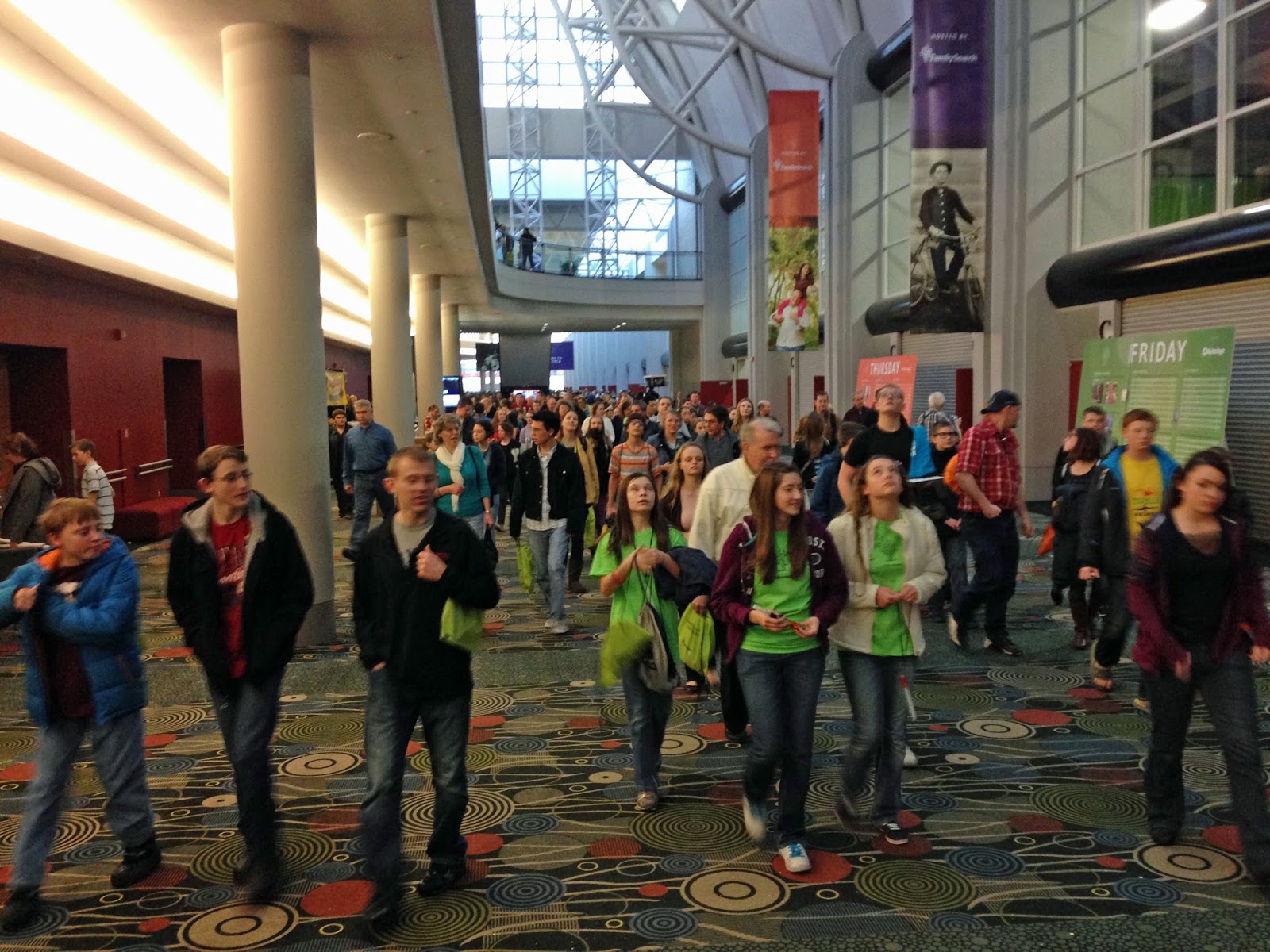
The day started out in a super awesome way! The 9,000 additional people who showed up for the Family Discovery Day have started to make their way into the Salt Palace! Now the Expo hall is filing fast with renewed enthusiasm and excitement. There are about 4,500 youth, some wide-eyed and apprehensive. We will see how that progresses throughout the day. 

What can I possibly say about the keynote speakers today that most of you watched, either in person or over the internet, but WOW!  First, I have never seen anyone talk a s  f-a-s-t  a s Todd Hanson, the producer of The Story Trek. I thoroughly enjoyed the levity, the intensity, and the joy of his Searching For A Story clips.  He is adept at pulling the personal story from other's hearts and sharing it with us. I will be a devoted follower of his show from this point forward! 
If you want to watch the program you can! If you cable or satellite TV has access to BYUtv you can view it there. If not, you can watch the program online at BYUtv - The Story Trek. Register for a free account. 

Stephanie Nielsen, author of the NieNie Dialogues blog, is one tough young lady! I don't remember the last time I was so proud of someone for learning to overcome the worst of the worst and be willing to speak about it and share her experiences with the world. I was honored to be in attendance during her keynote address. Her story of survival to live a new life is breathtaking. Her belief in God has certainly given her extraordinary strength of spirit and body.


Saturday's  FAMILY DISCOVERY DAY was a super special day for LDS members, both adults and youth, and anyone else who chose to attend the sessions!

As I mentioned above, there were an additional 9,000 people in attendance on Saturday above the 8,000 in attendance throughout the prior two or three days. RootsTech made room for about 4,500 adults and about the same number of youth for one just this one day. You might have thought it would be a nightmare but it was wonderful. Have you ever seen so many youth at a genealogy conference in your life? Well, take a look...
Mostly youth registering for their Youth Discovery Day at RootsTech!


Youth enjoying the Expo Hall
Having fun at the Studio C booth
Youth with their matching shirts and colored RootsTech bags
Interacting with the youth was an enlightening experience. Some were walking around just trying to absorb the incredible amount of electronic media, mini-classes, and activities with wide eyes. Others, were just having fun, while still others were so excited to learn anything they could possibly cram into those active brains of theirs!  So refreshing to see and hear the buzz.

They were treated to inspirational messages from leaders of the LDS Church - Elders' Neil L. Andersen, Allan F. Packer, Bradley D. Foster.Other speakers included Elder Enrique Falabela, Heidi Swinton and John Bytheway. The youth have a particular love for the humor of John Bytheway!  The center of their message was to encourage youth to record, preserve and share their family stories. They were taught about the powerful features of the FamilySearch Family Tree and how to help others with their family history - most importantly to teach their family members to seek out their kindred. 


I particularly liked Elder Foster's presentation he gave to the youth on Saturday. He referenced a question that was posed in the prior month's Parade magazine, which asked: When a team of psychologists measured children's resilience, they found that kids who _______ were best able to handle stress.
   a. Ate breakfast together every day
   b. Knew the most about their family's history
   c. Played team sports
   d. Attended regular religious services

The answer was b. The more children know about their family's history, the stronger their sense of control over their lives and the higher their self-esteem. The reason: "These children have a strong sense of 'intergenerational self'-they understand that they belong to something bigger than themselves and that families naturally experience both highs and lows."

We are all related. It's a matter of numbers back to Adam as to where we fall in this world family tree. (So be careful what you say to your neighbor or friend!) Each person has a story that tells who we are, which in turn, tells us who we are to become. There are 156,000 people on earth who leave us every day; we call that death. There are 384,000 new arrivals a day that we refer to as births. By the year 2015, it is expected that the earth will be home to 9 billion people. With the aid of technology we CAN connect them all together.

Comparing family history to a headstone in a cemetery, you have a name, a birth date, dash, a death date. However, the dash is what we are trying to identify -- it's our history.

Quotables: "What I would give for one tweet from my great-grandma!"

"Genealogy changes charts, but, Family History changes hearts!"

Overcome your barriers: It's not just for old people; it's not too hard; it's not too much technology. Let the youth lead! They will search out our kindred!

Elder Foster was very clear about the importance of all family members in searching for and learning about the dash between the dates of our kindred.

HELPFUL LINKS
To download and watch Elder Bradley Foster's presentation, click here.

Keynote presentations on video for Judy Russell from Friday's session and Todd Hansen.

If you or your group are interested in hosting a Stake Family History Fair, check this out.

Elder Allan Packer's presentation - Spiritual Passport

Elder Neil Anderson Youth Devotional

Plan right now to attend RootsTech 2015 which will be held February 11-16 in Salt Lake City, Utah!